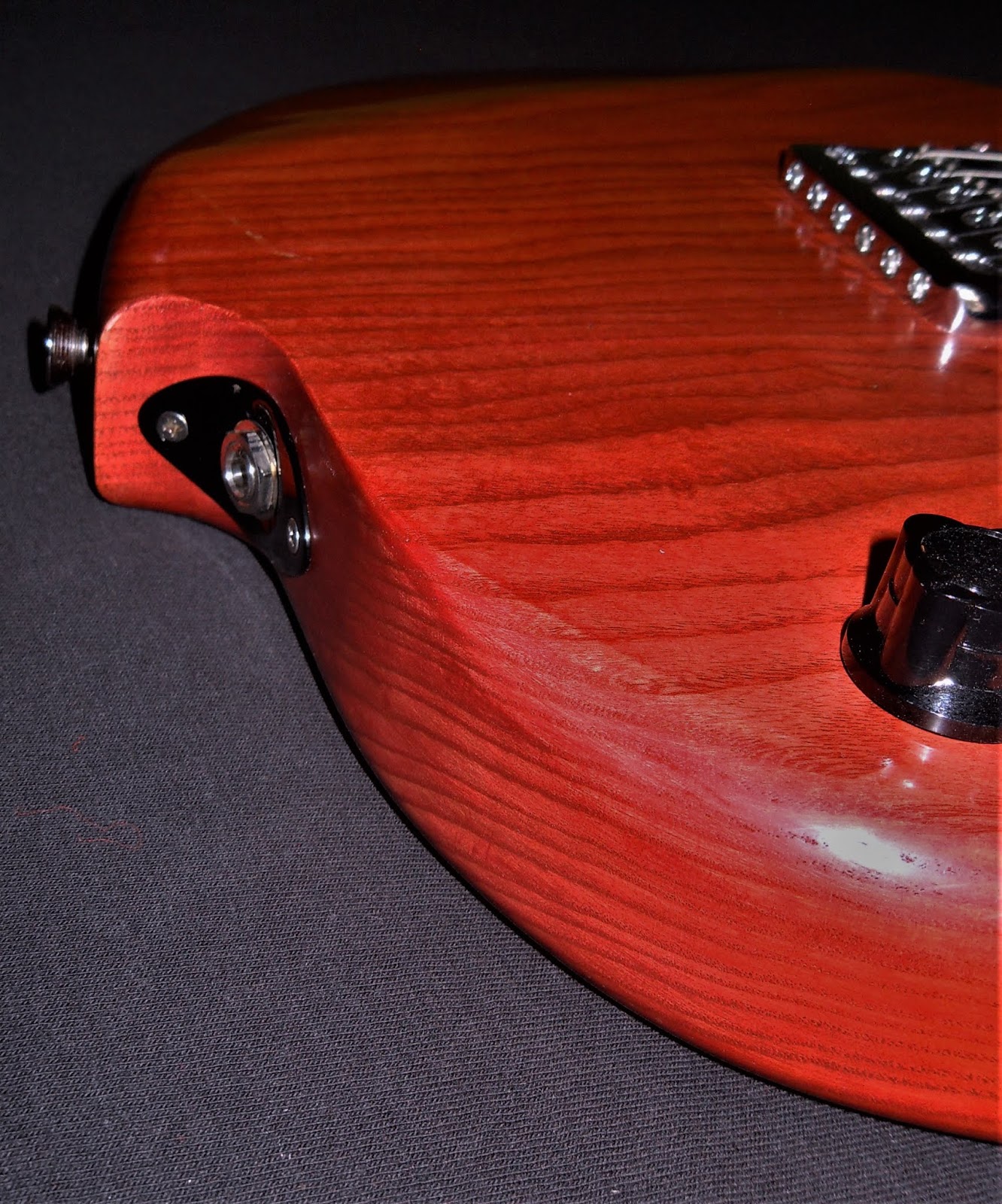
In my online absence I've collected quite a few comments and questions, going back all the way to the end of 2014.
First off let me just apologize for letting it go for so long. Next, I need to thank everyone who has taken time to check out my site here and especially those of you who have left comments. The feedback has all been wonderfully positive and inspires me to keep up with the site. Thank you so much!
As for questions about instruments, I'll go through some more general ones first, then get into the more specific ones.
To begin with, I have to announce that I am NOT taking any commission work. The one instrument I was hired to build through this blog almost ruined luthiery for me completely. I was really unhappy with the final product and felt like I had failed my client and myself. This was a huge part of my neglecting the blog (along with the shift to piano work).
A full post on that instrument is coming soon.
Here's a sneak preview of the headstock, which is actually one part of the instrument I am happy with.
Another commonly asked question is if I have plans or blueprints for any of my instruments.
Allow me to get a little art-defensive right now... No. Don't get me wrong, I'm flattered beyond belief that anyone would want to build something based on something I've built. I definitely want to encourage anyone who is interested in building string instruments; and it's true that going off of existing plans is extremely helpful especially when just starting out. But, I feel as though designing is part of the building and learning process, and it comes down to pulling out a pencil and paper and going at it.
I have used existing plans or instrument designs as a starting point for instruments I've built, but I tend to re-draw a lot and make the instrument look like mine rather than something that's already out there.
For instance, the Baroque guitar I made was traced from Stradavari's guitar plans. All the aesthetic designs got changed from the original, though.
Another example is a guitar I built for a friend. He really wanted to me to make him a guitar but he also really wanted a Telecaster Thinline. I got as close as I felt I needed to in order to capture the sound and feel he was looking for without just doing a copy.
The thing is, there are already enough Fenders, Gibsons, and Martins in the world; do we really need any more?
Again,
please don't take this as me being proprietary or secretive. I just
have strong personal opinions about creating original instruments. Also, I'm pretty lazy and don't make proper blueprints. My planning usually ends up on numerous scraps of paper and re-drawing everything out to print copies does not interest me.
That all said, I am more than willing to answer questions and share experience, ideas , or measurements about any of my instruments.
OK, onward!
A number of people have asked about buying some of the instruments on my blog, especially the charango. Well...again I'm going to claim my internet ineptitude as a big part of ignoring that issue. I don't like conducting business online. I know, I should go back to the 90's with that attitude, but I'm still not ready to take that step. I do intend to sell some of my instruments (I sure ain't playing them); I just need the right outlet to do it.
The charango is a bit of a different story. It is another of my instruments which I'm not satisfied with how it turned out. It's just too quiet! I think I need to thin the top somehow. Unfortunately some spots on the inlay are already dangerously thin, and I fear sanding through if I just work from the outside.
At some point I plan to try improving the sound (maybe it just needs better strings). Until then it's not really for sale.
In the future I may figure out how to sell my instruments online, considering that going to local music stores might not be an option for quite a while.
Since we're on the topic of the charango, let's start there with some of your questions.
Looks nice. Did you by chance record an audio/video of how it sounds?
Yet another thing I'm not rightly equipped for. I intend to make some sort of recordings of as many of my instruments as I can. The recording quality may not be the best until I have better gear. I should probably do a before/after recording of el charango if I do end up working on the soundboard.
Looks great! Why is the sound hole oval?
The small guitar, el charango, and quite a few other of my instruments have oval soundholes. I guess I was inspired by really old Gibson guitars and mandolins. I always thought they just looked classy. Except my ovals go with the strings rather than across the strings like Gibsons. The thought behind that was to focus the soundwaves coming out of the hole right onto the strings and, I don't know, energize them? That's probably bathtub science but it makes for a good justification to use oval soundholes.
The inlay material you used were all natural stuff or man made material
as well? If man made, when sanding it down at the end to make is flush -
after the epoxy, dont the man made face gets scratched and destroyed?
The bouzouki inlays are made from abalone, pink and gold mother-of-pearl, black pearloid, and green swirl acrylic. Yes, when the epoxy filler is sanded down, all of the inlay material gets scratched. I will typically use a sharp scraper to get rid of the excess epoxy. This creates way less surface scratching. After that only very fine grit sanding is needed (600 then 1000). Sometimes I'll buff out the inlay on the buffing wheel as a last step.


Dear Joel, I am simply amazed at and appreciate so much, the explicit
way and Detail you have indulged in to articulate all the different
steps of your reconstruction.
Question 1: What is a "tuner"? Is that the metal
liners of the frets?
Question 2: Why in the world can a luthier not glue wall paper into the
bowl and just leave it natural Wood the way it is? ( I will never get
this part of the Greek touch, but go ahead and try to explain it to me.)
What is now missing is for you to Play a hasapiko or zeibekiko on your
Bouzouki and put the Video on your site! Thank you for the wonderful
Bouzouki blogspot.
I suppose by "tuner" I meant tuning machine. As far as the reasoning behind the wallpaper glued inside lots of Greek bouzoukis: the inside seams of bowl-shaped instruments can look pretty rough, especially if veneers are used between each of the staves. If you consider how much time is put into the outside appearance of fancy bouzoukis, then why wouldn't you want to make the part you see through the soundhole look flashy, too? I just did it to follow tradition, I guess. Plus I happened to have that paper which matched my inlay design so well, I couldn't not use it.
Would the diaphragm out of an air horn work as a resonator? I have some
old truck air horns I was toying with building one of these out
of…thanks,
I hadn't thought of that but it seems like it might work really well. If you did go with the air horn diaphragm I'd be interested to know how it turned out.
I've
been thinking quite a bit around this concept and electro-magnetic
amplification.
I've Read somewhere that some early solid Fender had placed a
coil under a floating bridge, reading the bridge movement rather than
the strings.
The signal was weak but any way there was a signal that allowed for
amplification.
There are some issues with magnetic pu:s and bowed strings. Placing the
coils correctly to be sensitive to horisontal string vibration, although
it's perfectly possible.
However, a coil should also be able picking the needle vibrating against
a resonator. Probably this would produce an amplified tone somewhat
more alike the typical acoustic resonator sound.
on resonator violin
I guess I'd agree that a magnetic coil pickup could read the vibrations of the needle, or in my case bolt, attached to the resonator. It would probably involve a specifically designed pickup and some more elaborate mounting. A piezo pickup could likewise be attached more directly to the resonator to produce a signal closer to the sound coming from the horn. I mounted piezos to the bridge just because that's what I was familiar with.


The left arm should be stretched out all the way to the back of the neck.
Correct? Unless you play lefty? No idea.
So thank you to anyone bothering to read this far. I will try to keep things interesting in upcoming posts. Sorry for being rambly after taking forever to post anything at all. Feel free to ask me more; I may not be very helpful, but I'll try to respond as best as I can.